


With a focus on promoting participation, CPAdvance™ for occupational therapists provides critical training on the principles and specific interventions that are best supported by evidence for young children with, or at risk of, cerebral palsy or similiar neuro-disabilities.
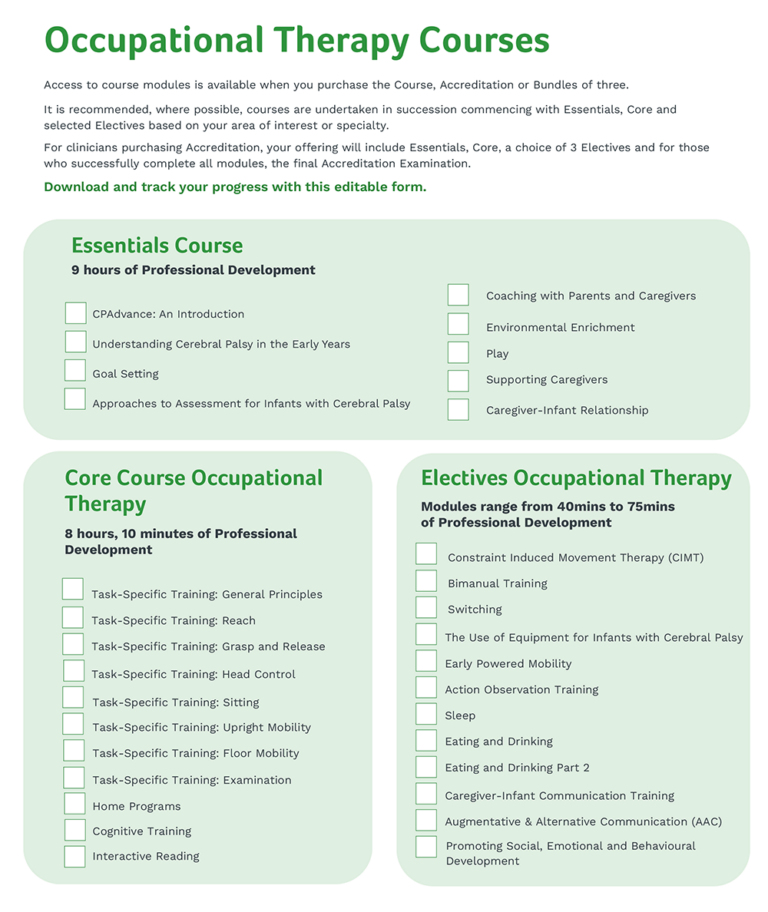
Click here to view and track your learning journey.
Course options include:

Be formally recognised with the completion of 22 modules plus a free introductory module, accreditation exam, 2 years access to CPAssist and ongoing webinars and community communications. Accreditation recognises demonstrated advanced knowledge, clinical reasoning, and competence in evidence‑based intervention.
Global Launch – 15% off.
Discount applied at checkout.
Offer expires 30th November 2026.
Curate your own program by selecting small bundles of three modules from both Core and Elective Courses with 12 months of access to complete your learning at your own pace.
This approach enables you to strategically prioritise both your professional goals and financial investment, focusing on the knowledge and skills most relevant to your current practice.
Build Your Own Learning Journey
The Learning Journey offers a flexible and tailored approach to professional development, empowering you to shape your education according to your evolving needs.
With this pathway, you may curate your own program by selecting small bundles of three modules from both Core and Elective modules, with 12 months of access to complete your learning at your own pace.
This approach enables you to strategically prioritise both your professional goals and financial investment, focusing on the knowledge and skills most relevant to your current practice. Upon completion of each module, you will receive a digital Certificate of Completion, supporting your ongoing professional development requirements.
For those intending to progress toward Accreditation, the Learning Journey can serve as a recognised pathway. Applicants must complete the Essentials course, all Core modules within their discipline, and a minimum of three Electives—either through module bundles or by completing full courses.
Essentials Course content
Cerebral palsy is the most common motor disability in childhood – yet every child is unique.
Today, we have powerful knowledge showing that diagnosing and intervening earlier can change life outcomes in profound ways for children with or at risk of cerebral palsy and their families. This introductory module establishes the three best practice key principles of early intervention that underpin each module of CPAdvance™.
By laying these foundations, this module offers learners a lens through which they can best engage with the knowledge and skill development offered throughout this program of learning, supporting real-life practice changes.
What is cerebral palsy? What causes it? How is it diagnosed?
This module aims to equip learners with foundational knowledge relating to cerebral palsy, with a particular focus on how it presents in the early years.
By completing this module, learners will gain an understanding of cerebral palsy diagnostic pathways, types, topographies and prognostic trajectories, as well as common comorbidities.
By deepening knowledge of cerebral palsy, learners will strengthen their ability to support caregivers in tailoring the most beneficial interventions for their goals and facilitating truly impactful therapy.
Goal setting with children and their families is a well recognised building block for effective practice. Yet, research shows that goal setting is often overlooked. Why do goal setting practices often fall short?
This module introduces the Rehabilitation Evidence-Based Decision Making (READ) model – a step-by-step layered process to setting goals with families.
Learners will understand how to collaboratively elicit and establish goals, transforming conversations with caregivers into caregiver-led plans that reflect evidence-based interventions that drive meaningful progress.
With the various assessments available, each with a different purpose, it is easy to feel uncertain as to which assessments should be prioritised and why. Sharing assessment feedback with families can also be complex and challenging.
This module aims to upskill learners in the assessment phase of care. Through this module, learners will be able to identify best available assessments for infants with or at risk of cerebral palsy, and apply assessment information to guide evidence-based intervention selection.
This module also aims to equip learners with assessment feedback skills using the SPIKES framework, promoting family engagement and therapeutic outcomes.
Coaching is an evidence-based approach in paediatric rehabilitation, that focuses on empowering families to unlock their child’s potential.
This module will introduce learners to the principles of coaching – what it is and how to do it with families to enable collaborative problem-solving so that they may enjoy the benefits of being informed decision makers in achieving their goals.
Our everyday environment is filled with opportunities for growth and learning. But how effectively do we intentionally leverage this potential to make therapeutic gains?
This module supports learners to understand how to optimise a child’s environment to stimulate social, cognitive, motor and sensory growth.
By understanding the evidence and theory of environmental enrichment, learners will develop the knowledge and skills required to support families to enhance their infant’s environment through paediatric rehabilitation service provision.
It is well known that ‘play’ is the most important job a child will ever have. But how well do we optimise play opportunities to achieve therapeutic goals?
This module supports learners to identify strategies to integrate play into therapy interventions by developing an applied understanding of the key ingredients of play that maximises an infant’s enjoyment, motivation and skill building.
Children learn more when they are having fun – making play essential for therapy intervention effectiveness.
Research consistently shows that caregiver well-being is linked to infant development. Yet, research also tells us that caregivers of children with disability are more likely to develop mental health and wellbeing challenges.
As the effectiveness of parent-led interventions and family centred practice is increasingly recognised, the need to support caregiver wellbeing and mental health in paediatric services is also emphasised.
This module aims to equip learners with principles and strategies to embed supporting caregiver mental health and wellbeing as part of routine practice. Caregiver well-being drives infant outcomes.
The bond between a caregiver and infant is more than a source of comfort; it’s the emotional foundation infants rely on to safely explore their world.
This module explores how attachment forms in the earliest days of life, drawing on the Circle of Security framework, with a focus on responsive caregiving through delighting, noticing and responding.
Given the added stressors many families of infants with cerebral palsy face, learners will build skills to identify when a family may need extra relational support and incorporate general attachment-promoting strategies into everyday practice, knowing when to refer families on for more specific relationship-focused support.
Core Course content
Cerebral palsy is the most common motor disability in childhood – yet every child is unique.
Today, we have powerful knowledge showing that diagnosing and intervening earlier can change life outcomes in profound ways for children with or at risk of cerebral palsy and their families. This introductory module establishes the three best practice key principles of early intervention that underpin each module of CPAdvance™.
By laying these foundations, this module offers learners a lens through which they can best engage with the knowledge and skill development offered throughout this program of learning, supporting real-life practice changes.
All children with cerebral palsy have some level of impairment in their motor development. Early intervention emphasises the importance of practising specifically what the infant and the family want to learn, rather than general milestone-based programs.
Task-Specific Training is a powerful approach grounded in neuroplasticity and motor learning principles designed to develop skills in specific functional tasks.
This opening module aims to help learners understand the neuroscience evidence-base related to task-specific training and outline the principles of this approach for application in clinical practice.
Reach – a fundamental motor skill that opens the door to exploring the world and connecting with people.
Reaching is an essential component of most tasks – yet can be challenging for infants with motor difficulties.
Extending from Task-Specific Training – General Principles, this module applies these principles to the task of reaching.
Through this module, learners will be able to identify the stages of reach, the factors affecting reach for infants with cerebral palsy, and how to effectively tailor task specific training to progress an infant’s reaching skills.
Effective hand function requires both grasp and release. Just like reach – grasping and releasing is a fundamental motor skill that enables exploration, discovery and independence.
While every infant is different, grasping and releasing can be challenging for infants with motor difficulties.
Extending from Task-Specific Training – General Principles, this module applies these principles to the task of grasping and releasing. Through this module, learners will be able to identify the stages of grasp and release, factors affecting grasp and release for infants with cerebral palsy, and how to effectively tailor task specific training to progress an infant’s grasping and releasing skills.
Head control is foundational to postural stability, visual engagement and functional movement.
With greater head control comes development of higher-level motor skills and greater independence.
Extending from Task-Specific Training – General Principles, this module applies these principles to the task of head control.
Through this module, learners will be able to identify the stages and function of head control, the factors affecting head control for infants with cerebral palsy, and how to effectively tailor Task-Specific Training to progress an infant’s head control.
Sitting is a pivotal task, allowing infants the freedom to use both hands to explore and interact with the world around them whilst building the strength and control for future movement.
However, sitting can be difficult for infants with cerebral palsy due to the muscle tone, balance, and coordination required to maintain an upright position.
Extending from Task-Specific Training – General Principles, this module applies these principles to the task of sitting.
Through this module, learners will be able to effectively tailor activities to develop sitting balance, weight shifting and transitions as part of task specific training to progress an infant’s sitting skills.
Many, but not all, children with cerebral palsy will learn to stand and walk. The complexity of controlling trunk and limbs whilst defying gravity is challenging and can take a long time to develop. Yet, standing and walking is often identified as a priority area by families to target.
Extending from Task-Specific Training – General Principles, this module applies these principles to the task of upright mobility.
Through this module, learners will be able to design task-specific training activities to develop weight shifting, cruising, stepping, walking and high-level mobility skills.
When something captures an infant’s interest, the desire to get closer inspires rolling, pivoting, reaching and crawling. These early movements support infants to decide where to go and how to get there, fueling curiosity and connection with their world.
For infants with cerebral palsy, type, topography, severity and associated impairments all impact how and when infants start to move on the floor.
Extending from Task-Specific Training – General Principles, this module applies these principles to the task of floor mobility.
Through this module, learners will understand the benefits of early practice in prone and develop skills in task-specific training activities to support infants to mobilise and explore on the floor.
How well have you understood task specific training?
Task-Specific training: Examination offers a unique opportunity to consolidate learning from all task–specific training modules.
This module requires learners to apply Task-Specific Training knowledge and skills to a series of real-life clinical scenarios, including being able to identify factors affecting goal attainment, stages of motor learning, and key concepts to support motor skill acquisition including specificity, grading, repetition, practice and feedback.
Home programs extend therapy beyond individual therapy sessions by embedding learning opportunities into everyday family routines and activities.
When developed collaboratively, home programs become a meaningful part of family life rather than an additional burden.
In this module, learners are introduced to the evidence-based Partnership Home Program Model, a five-phase framework for developing, implementing and evaluating home programs with caregivers.
Through practical case examples, learners will build skills in establishing collaborative partnerships, setting caregiver-led goals, selecting meaningful therapeutic activities, supporting implementation through coaching, and evaluating outcomes to maximise participation and developmental progress for infants with cerebral palsy and their families.
Infants are scientists, learning through curiosity, experimentation and discovery. Yet for many children with cerebral palsy, physical limitations can restrict access to the toys, tasks and environments that drive cognitive development.
In this module, learners are introduced to the fundamentals of cognitive training and the close relationship between motor and cognitive development.
Through practical examples, learners will develop strategies to enrich environments, support child-led problem-solving, and embed cognitive training within everyday routines and concurrent interventions to promote learning, exploration and self-agency.
Interactive reading is more than a shared reading experience. It is an evidence-based intervention that supports language, cognition, social-emotional development and caregiver–infant connection.
This module introduces the ABCs of Interactive Reading: Adopt reading early, Build caregiver capacity, and Customise your approach to target transdisciplinary goals.
Through practical examples, learners will explore how to use interactive reading as a standalone intervention, an adjunct to other therapies, or an enrichment strategy within everyday routines.
By the end of the module, learners will be able to tailor interactive reading to an infant’s goals, abilities and family context, empowering caregivers to turn everyday story time into meaningful, goal-directed learning opportunities.
Electives Course content
What if encouraging the use of one hand could unlock new possibilities for learning, play and independence?
Constraint-Induced Movement Therapy (CIMT) is one of the most researched interventions for children with unilateral cerebral palsy and may also benefit children with asymmetric hand use. Grounded in neuroplasticity, CIMT uses repetition of intensive, task-specific practice to strengthen the skills of the assisting hand through enjoyable activities at the just-right challenge.
This module explores the evidence underpinning CIMT, considerations when choosing CIMT or bimanual therapy, and practical guidance on when, why and how to apply CIMT to maximise hand function and participation.
What if every day play could help a child learn to use both hands more effectively?
Many of life’s most meaningful activities, from getting dressed to opening containers and joining in play require two hands working together.
Bimanual therapy is an evidence-based intervention that helps infants and children with asymmetric cerebral palsy develop coordinated use of both hands during everyday activities.
Through enjoyable, task-specific practice, infants learn to engage their more-affected hand in meaningful two-handed tasks, supporting greater independence and participation.
This module explores the evidence underpinning bimanual therapy, considerations when choosing bimanual therapy or CIMT, and practical guidance on how to apply bimanual interventions in clinical practice.
What if the smallest movement could unlock a world of opportunity?
Adaptive switches provide infants with cerebral palsy a way to access play, communication and mobility, turning a single action into meaningful, fun-filled learning experiences.
This module presents switching as a flexible intervention, ranging from an enrichment strategy to an early intervention that supports the development of lifelong alternative access skills.
Learners will develop the skills to select and set up a range of switch-based assistive technologies, create engaging and motivating switch-accessible activities, and support skill progression by partnering with families to embed switch use into everyday routines. The focus is on promoting independent, child-led participation in meaningful activities.
Equipment is never the goal, it’s a solution.
For infants with cerebral palsy, the right piece of equipment at the right time can support comfort and safety, participation and skill development.
This module guides clinical reasoning around equipment use, including understanding early topography and motor trajectory, and choosing between standard baby equipment and specialised products across sitting, standing, walking, bathing, toileting and community participation.
Learners will build skills to work in partnership with families to introduce and review equipment in line with best-practice principles, ensuring every device serves a clear, evolving purpose in the infant’s development.
When an infant learns to move and explore their surroundings, they gain the opportunity to follow their curiosity, discover new experiences, and engage with the world around them.
For infants with cerebral palsy, early powered mobility can provide a means of self-initiated movement during a critical developmental period.
This module introduces early powered mobility through the lens of the ONTime Mobility Framework. Learners will develop the skills to identify infants who may benefit from early powered mobility, assess individual needs, select appropriate devices, and embed safe, enjoyable powered mobility experiences into everyday routines.
The goal is to promote autonomy, exploration, participation, and access to meaningful movement experiences.
Every time an infant watches a caregiver reach, grasp or play, their brain is quietly rehearsing that same movement.
Action Observation Training harnesses this natural mirror neuron process to help infants with cerebral palsy build motor skills before they can physically attempt them.
This module explores the evidence behind this neuroscience-informed intervention and its four-phase cycle — Observe, Practice, Feedback, Reinforce — for use as a low-cost, accessible adjunct to therapies like constraint-induced movement therapy.
Learners will build skills to structure an effective home practice dose and coach caregivers to weave Action Observation Training into everyday routines that are both effective and sustainable for families.
It’s normal for babies to wake through the night, but when sleep difficulties persist, the effects ripple through the whole family.
Sleep problems affect around half of all children at some stage, and are even more common for infants with cerebral palsy, with roughly one in four experiencing a diagnosed sleep disorder.
This module builds understanding of typical infant sleep development and the factors that can disrupt it, equipping therapists to routinely screen for sleep problems using validated tools, support caregivers with practical sleep hygiene strategies, and confidently refer families on for medical or specialist input when needed.
Long before infants have words, they communicate through emotion and behaviour. The first three years of life are a critical window for building the neural pathways that underpin lifelong social and emotional wellbeing.
Infants with or at risk of cerebral palsy face a greater likelihood of social, emotional and behavioural challenges, making this window especially important.
This module explores how early intervention therapists can support caregivers to notice, listen to and respond with curiosity to their infant’s emerging emotions and behaviours.
Learners will build skills to recognise when social-emotional development is impacting how an infant is learning and developing, and confidently refer families to evidence-based targeted services when needed.
Communication is essential – it allows the expression of need and identity, connection with loved ones, and full participation in life. However, most children with cerebral palsy experience difficulties with communication.
This module aims to upskill learners in the principles of communication development. Complemented by coaching and a family centred approach, through this module learners will be able to apply evidence-based principles and communication strategies to identify appropriate communication goals, assessments and interventions at the just right level of challenge to progress communication skills of infants with or at risk of cerebral palsy.
Approximately 25% of children with cerebral palsy are unable to produce functional speech.
AAC can support breaking barriers to communication – though this can often feel complex. Challenging factors can include resources, family uncertainty, or simply not knowing where to start due to the range of systems and devices available.
This module aims to support therapists to understand the purpose, benefits of AAC – when and how to use specific AAC approaches across a range of diverse clinical scenarios to support the advancement of life-long communication skills in children with or at risk of cerebral palsy.
Mealtimes are more than just food and drink – they are moments of connection, culture and shared ritual for families and community.
Children with cerebral palsy often experience challenges with eating and drinking, having significant nutritional and social implications. As the primary role of a caregiver is to nourish their baby, it can be very distressing when eating and drinking is challenging.
This module, the first in in a two-part series, aims to equip learners with the knowledge and skills required to support infants with or at risk of cerebral palsy to develop eating and drinking skills, with a particular focus on managing fluids.
The balancing of skill development and safety can be complex for therapists, particularly in developing eating and drinking skills with infants who have or are at risk of cerebral palsy where there is a higher risk of oropharyngeal dysphagia.
This module is the second in a two-part series that aims to equip learners with the knowledge and skills required to work with these infants in developing eating and drinking skills. This module focuses on managing oral intake of solids.
Have a question or query? Click here
We’d love to help you.