


Across more than seven hours of interactive e-module based learning, complemented by recommended resources, you will develop strong theoretical knowledge and practical skills in goal setting, assessment, working with caregivers, and adapting natural environments and activities.
With a focus on practice principles, the Essentials course strengthens your clinical decision-making through use of real-life videos, case-based scenarios, and accounts from parents, people with lived experience and experts. This holistic approach strengthens practice by equipping learners to integrate clinical decision-making and evidence directly into their everyday work, irrespective of resources available to the professional or family.

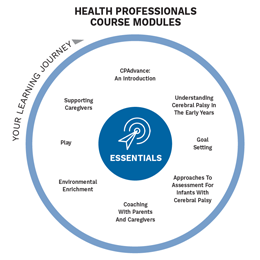
Click here to view your learning journey, what’s available now and what’s coming in 2026.
Essentials - Course content
Cerebral palsy is the most common motor disability in childhood – yet every child is unique.
Today, we have powerful knowledge showing that diagnosing and intervening earlier can change life outcomes in profound ways for children with or at risk of cerebral palsy and their families. This introductory module establishes the three best practice key principles of early intervention that underpin each module of CPAdvance™.
By laying these foundations, this module offers learners a lens through which they can best engage with the knowledge and skill development offered throughout this program of learning, supporting real-life practice changes.
What is cerebral palsy? What causes it? How is it diagnosed?
This module aims to equip learners with foundational knowledge relating to cerebral palsy, with a particular focus on how it presents in the early years.
By completing this module, learners will gain an understanding of cerebral palsy diagnostic pathways, types, typographies and prognostic trajectories, as well as common comorbidities.
By deepening knowledge of cerebral palsy, learners will strengthen their ability to support caregivers in tailoring the most beneficial interventions for their goals and facilitating truly impactful therapy.
Goal setting with children and their families is a well recognised building block for effective practice. Yet, research shows that goal setting is often overlooked. Why do goal setting practices often fall short?
This module introduces the Rehabilitation Evidence-Based Decision Making (READ) model – a step-by-step layered process to setting goals with families.
Learners will understand how to collaboratively elicit and establish goals, transforming conversations with caregivers into caregiver-led plans that reflect evidence-based interventions that drive meaningful progress.
With the various assessments available, each with a different purpose, it is easy to feel uncertain as to which assessments should be prioritised and why. Sharing assessment feedback with families can also be complex and challenging.
This module aims to upskill learners in the assessment phase of care. Through this module, learners will be able to identify best available assessments for infants with or at risk of cerebral palsy, and apply assessment information to guide evidence-based intervention selection.
This module also aims to equip learners with assessment feedback skills using the SPIKES framework, promoting family engagement and therapeutic outcomes.
Coaching is an evidence-based approach in paediatric rehabilitation, that focuses on empowering families to unlock their child’s potential.
This module will introduce learners to the principles of coaching – what it is and how to do it with families to enable collaborative problem-solving so that they may enjoy the benefits of being informed decision makers in achieving their goals.
Our everyday environment is filled with opportunities for growth and learning. But how effectively do we intentionally leverage this potential to make therapeutic gains?
This module supports learners to understand how to optimise a child’s environment to stimulate social, cognitive, motor and sensory growth.
By understanding the evidence and theory of environmental enrichment, learners will develop the knowledge and skills required to support families to enhance their infant’s environment through paediatric rehabilitation service provision.
It is well known that ‘play’ is the most important job a child will ever have. But how well do we optimise play opportunities to achieve therapeutic goals?
This module supports learners to identify strategies to integrate play into therapy interventions by developing an applied understanding of the key ingredients of play that maximises an infant’s enjoyment, motivation and skill building.
Children learn more when they are having fun – making play essential for therapy intervention effectiveness.
Research consistently shows that caregiver well-being is linked to infant development. Yet, research also tells us that caregivers of children with disability are more likely to develop mental health and wellbeing challenges.
As the effectiveness of parent-led interventions and family centred practice is increasingly recognised, the need to support caregiver wellbeing and mental health in paediatric services is also emphasised.
This module aims to equip learners with principles and strategies to embed supporting caregiver mental health and wellbeing as part of routine practice. Caregiver well-being drives infant outcomes.
Have a question or query? Click here
We’d love to help you.